Friday, 15 February 2019

What are you doing about all these potholes? - Ask the Contract Director #4


Ask the Contract Director!

We understand that as members of the public, you probably have a lot of burning questions regarding the roads around Buckinghamshire. Well, we’re giving you the opportunity to get your questions answered by Transport for Buckinghamshire’s Contract Director!
In each blog post in this exciting new series, we will be focusing on a different frequently asked question. This week, we’re answering:


What are you doing about all these potholes?


Grab a cup of tea, sit back and relax – we’re about to give you all the information you could ever need to know about potholes. Spoiler alert – there’s a lot!

What is a pothole and how is one made?

No, it’s not just a crater in the road that leaves you feeling overly frustrated on your drive to work. No, it’s not the entrance to a tunnel between here and Australia either (yes, this has been a genuine suggestion in the past).

A pothole is where the surface of the road has been eroded and a hollow has formed.

Potholes are most usually formed through a process called the ‘freeze-thaw’ cycle. As roads age, they become more porous, having been worn down by traffic. As the weather gets colder, the potholes can become filled with ice, forcing the hole to expand and push the tarmac up and out. Gaps are created in the tarmac when the ice thaws and turns back into water, and these gaps get bigger each time it freezes and thaws – this weakens the road. These gaps then cave in when traffic travels over the road, creating a pothole.


How do we find out about the potholes?

We can find out about potholes across the county in a couple of ways. Members of the public can report potholes to us via our online reporting tool, ‘Fix My Street'. Reports received by us are sent to the relevant Local Area Technician (LAT) to be inspected.

And speaking of our LAT’s, they proactively inspect their local areas for potholes and other road defects and highway issues, alongside our Highway Inspectors. All defects are inspected and assessed to determine whether a repair is required, and if so, what kind of repair it might need.

The roads are inspected regularly according to a schedule. This means a lot of potholes will be picked up by these inspections and programmed for repair.


How do we determine which potholes are in need of repair?

Around 2,000 potholes are repaired each month – yes, really!

Not every defect on the highway requires an immediate repair. All issues that are reported to us are reviewed within 10 days.

All repairs are based on the risk they pose to the public and depend on:

·        - The extent, depth and surface area
·        - The volume and speed of traffic
·        -  The location such as junctions and bends
·       -   Forecast weather conditions

We aim to make emergencies safe within two hours and other priority repairs within two, five or 28 days. Non-urgent defects will be added to future planned works.


What is the point of a temporary repair? Surely it’s better to fix it permanently the first time around?

It is, but sometimes a temporary repair is needed to make the road safe until a permanent repair is possible.


How do we fix a pothole?

When making a temporary pothole repair, the area around the pothole needs cutting out to make a uniform shape with no jagged edges. The pothole is then cleaned out and coated with a layer of binder to act as an adhesive. Next, the hole is filled with hot road surfacing material which is then raked and compacted. Once the material has cooled, the road can be reopened to traffic.

On rural roads, potholes are fixed using a technique called ‘spray injection patching’. These repairs come with a 12 month guarantee. Repairs made with a jet patching machine are quicker, more efficient, long lasting, low carbon emitting and applied cold so that they are ready to drive on immediately.


Why do we fix one pothole, but not another pothole on the same road?

This is a question we are asked on a regular basis. When we fill one pothole but not another just a few metres away, many people become frustrated with us – and the seeming lack of common sense behind this has been criticised.

The reason behind repairing one pothole but not another on the same stretch of road is very simple; we have a finite amount of finance, and therefore workforce, to fill the potholes. We have to use them effectively to ensure those requiring urgent repair are fixed first.

If we were to use resources filling in a non-urgent repair, a pothole of a higher priority may not be able to be repaired. Safety is our first concern, so urgent fixes must be done first. This means that sometimes, we will fix one safety critical pothole on a road, but not another.


Can I fix a pothole myself?
Well, we’ve already answered that one for you! Have a read here: https://tfblatestnews.blogspot.com/2019/01/can-i-repair-pothole-myself-ask.html 


Thursday, 7 February 2019

Why can't you just do your job properly? - Ask the Contract Director #3


Ask the Contract Director!

We understand that as members of the public, you probably have a lot of burning questions regarding the roads around Buckinghamshire. Well, we’re giving you the opportunity to get your questions answered by Transport for Buckinghamshire’s Contract Director!

In each blog post in this exciting new series, we will be focusing on a different frequently asked question. This week, we’re answering:


Why can’t you just do your job properly?


Our operatives are lovely guys and you may see them out and about across Buckinghamshire as they carry out their day to day duties and repairs. Whilst you shouldn’t distract them from their work too much, they are more than happy to tell members of the public about the work they’re carrying out, advise on a closure they’re putting in place or similar.

However, our operatives do not have knowledge of all the repairs and schemes being carried out across the county, nor do they have knowledge of every single pothole or road defect in the county. They will not be able to advise you of the status of your specific Fix My Street report or an ongoing enquiry.

Sometimes, our operatives are the only ‘face’ of TfB you will see, and so they can take the brunt of your frustration if you are being delayed by roadworks. Sometimes, you might end up having a bit of a rant to them about how long a job is taking, or why you have had to take a detour.

You might also disagree with the work an operative is doing. You might not understand why they're fixing this pothole, but not that one. You might not want to be stuck at the temporary signals they've put in place. You might just want to go about your day without TfB work interrupting it. 


Just a handful of TfB operatives!


We understand why people get frustrated by our works sometimes, but please remember to respect our workers at all times. They are just trying to do their job, and they deserve to be treated respectfully whilst doing so – just as you would expect at work. Too often we hear horror stories of abuse that TfB operatives have suffered because a member of the public isn’t happy about the works being carried out. Our operatives have had bottles thrown at them, been squared up to and sworn at by members of the public, pushed and shoved. They have even been driven at by angry drivers.

The abuse doesn’t stop at our operatives either – office based staff are often forced to deal with abusive messages on social media, hate-filled emails and letters and angry telephone calls. Like our operatives, they shouldn’t have to deal with this kind of behaviour just for doing their job. No matter how frustrated you might feel, it’s worth taking a moment to remember there is a real person at the other end of the phone or computer – a person who doesn’t deserve to deal with being sworn at, being called names or told they aren’t doing their job properly.

How would you feel if it was you being treated this way? If it was your partner, your child, your friend? You’d be appalled that they had to suffer abuse whilst carrying out their day to day jobs.

Our operatives and staff are people’s partners, children and friends. Above all else, they are all hardworking people with feelings who deserve to be treated with respect. Please allow them the right to complete a job without having to worry about their safety or wellbeing – and please show them the respect they deserve.


Follow us on Twitter | Like us on Facebook | Read our previous FAQ Post...

Monday, 4 February 2019

Can I Repair A Pothole Myself? - Ask the Contract Director #2


Ask the Contract Director!

We understand that as members of the public, you probably have a lot of burning questions regarding the roads around Buckinghamshire. Well, we’re giving you the opportunity to get your questions answered by Transport for Buckinghamshire’s Contract Director!

In each blog post in this exciting new series, we will be focusing on a different frequently asked question. This week, we’re answering:


Can I repair a pothole myself?


In short, the answer is no. Under no conditions should you ever try to repair a pothole, or any kind or road defect, yourself – and there are a number of reasons why.

First of all, this is a big no-no on from a health and safety point of view.

You could harm yourself or another road user whilst completing the repair due to the fact that you might not know what you’re doing or that you may use the wrong equipment or materials, which could result in an injury. 

Additionally, a road user might injure themselves on the defect that you have repaired. By repairing the pothole yourself, you then become liable for that pothole, and would be fully responsible for anyone trying to claim for damage or injuries caused by it. Could you guarantee that you have fixed it so well, it won’t fall through and will never damage a car or cause injury to a member of the public?

You also need the appropriate traffic management in place for repairing a pothole, and by repairing it yourself on an open road with no protection you are putting your life at risk. You could be repairing the pothole and a car might whizz around the corner and accidentally hit you. It’s not worth putting your life at risk.


Transport for Buckinghamshire has given five Parish Councils the responsibility of repairing potholes in their area, as part of the Additional Services Devolution Pilot. Buckingham Town Council, Gerrards Cross Town Council, Waddesdon Parish Council, Stone Parish Council and Mentmore Parish Council are all participating in the pilot, which means they are responsible for repairs to carriageway defects, repairs to footway defects and miscellaneous defects such as kerb and sign post defects.

Repairing a pothole, or any other kind of road defect, should be left to the professionals who are trained to do the job and are equipped with appropriate PPE and equipment to carry out the repair.

It can be frustrating when you see a pothole on the road, report it and then it doesn’t get repaired as quickly as you would like. However, there is always a good reason behind why we haven’t repaired a pothole. We follow a risk based approach that determines if we do or don’t repair a pothole, and we do this in the most value for money way possible. You can read more about our criteria here: https://www.buckscc.gov.uk/services/transport-and-roads/day-to-day-highway-maintenance/ 


Follow us on Twitter | Like us on Facebook

Friday, 25 January 2019

Why are there roadworks and/or temporary signals in place but no one working on site? - Ask the Contract Director! #1


We understand that as members of the public, you probably have a lot of burning questions regarding the roads around Buckinghamshire. Well, we’re giving you the opportunity to get your questions answered by Transport for Buckinghamshire’s Contract Director!

In each blog post in this exciting new series, we will be focusing on a different frequently asked question. This week, we’re answering:


Why are there roadworks and/or temporary signals in place but no one working on site?


We often hear about your frustrations across Facebook and Twitter, and one that crops up more often than others is when you find yourself held at temporary signals or when you drive past a site where work should be happening, but you can’t see anyone working there. It can be annoying, particularly if this site has meant you’ve been delayed or had to use a diversion route. However there are a few reasons why you might not see anyone on site.

There are many organisations working on the network and if the work is not being carried out by us, we will investigate it.


Waiting for materials
Sometimes operatives are waiting for materials to be delivered, which is why you might see them sitting in their van or standing around the site. It may look like they’re ‘not working’, but the reality is they just can’t yet!


The work is being completed by different teams and contractors
Many works are completed in different phases, with each phase being carried out by a different team or specialist contractor. Sometimes, a site may be left unoccupied after one section of work is complete and the relevant team leaves and the next team haven’t arrived.


Testing of water mains
If new pipes have been installed on a site, the water mains needs to be tested. This means you might not see any physical work going on at the site, but it doesn’t mean work isn’t happening.


There is an excavation
If there is an open excavation on the site, equipment needs to be left up even if nobody is working there that day, to keep the public safe.


There’s been a gas leak
If there has been a gas leak, venting needs to take place to disperse the build-up of gas deposits, which means you won’t see anyone actively working on the site.


Noise implications
Sometimes work can’t be done during certain hours (usually at night) because of the environmental noise implications.  Similarly, sometimes works are planned for set times of the day, which means you won’t always see work going on.
The site won’t be packed up out of hours, which means sometimes you’ll drive past an empty site.


Weather conditions
A lot of our work is weather dependent and if we are working there one day, the weather may prevent us from working there the next. The site wouldn’t be taken down, it would just be left there until the weather had improved, and so you may see an empty site with traffic signals.


Waiting time is needed!
Tarmac or concrete reinstatement takes time to cure, and no work can be carried out on site whilst this is happening.


A lunch break!
Yes, even TfB operatives get lunch breaks! If you see them sat around eating, it isn’t because they’re choosing not to work – they could simply be on a lunch break!


There is more to a work site and/or temporary signals than you might think – a lot of work goes on behind the scenes that you don’t necessarily see. Next time you see an empty site and feel angry that no one is working but your route has been interrupted, remind yourself of the reasons above. Sites aren’t left empty unnecessarily – there is always a reason.


Follow us on Twitter | Like us on Facebook

Tuesday, 20 November 2018

'What the heck is a hoar frost?' and other winter FAQs


The cold weather has started settling in, and our gritters went out for the first time at the end of October. Here are some answers to frequently asked questions that crop up every year when we begin our winter service...


Can you refill my salt bin?

Salt bins are stocked at the beginning of every winter, and then restocked depending on demand and weather conditions. You can report empty salt bins using Fix My Street – pinpoint the location and select ‘salt bin refill’ from the drop down menu. We can’t fill bins immediately in response to each report, but bins reported empty will be added to the list for the next cycle of top-ups. There are over 1,200 salt bins across Buckinghamshire which TfB are responsible for; each bin holds about half a tonne of rock salt, the same stuff used on the roads.


My road doesn’t have a salt bin – can you provide one?

We can sell salt bins to private organisations with links to Bucks County Council, such as social care properties or schools. We will consider requests for new salt bins at known trouble spots on the public highway, however funding for new salt bins will need to be provided externally. We will consider requests from private organisations to buy salt bins as well; requests can be made using the contact forms on our website. 

Do new salt bins cost anything?

Initial setup costs are £475 per salt bin but once they are installed we will have no future liability for them, though it may be possible for us to refill private bins at a cost. For new estate roads all new salt bin requirements will be assessed, and the developer would fund the cost of the new salt bin and salt.

Why don’t you grit my road?

Our primary salting routes cover the most important roads to keep everyone moving, covering 1405km of the county's A and B road network – that’s about 44% of the total network, and is more than many local authorities grit. In times of very severe weather salting will be carried out on secondary routes as well. These generally include classified roads which are not included in the primary routes, unclassified roads serving communities of 200 dwellings or more and unclassified roads with a gradient of 10% or less. In general, the secondary salting network will be treated in the event of severe ice or snow. 


Why are you gritting, it’s not even cold?!

Our first gritting run this year was really early, 26th October (there was a lot of excitement in the office at this surprising news) and several people questioned why we were salting when the forecast wasn’t that cold. The simple answer is; because road surface temperature is often several degrees lower than air temperature. We have a tried and tested system for making the gritting decision during winter – our dedicated winter team receives a detailed weather forecast analysis every day, which contains information on air temperature, road surface temperature, likelihood of snow and ice, humidity and wind speed. Using the data they are given, the team decides whether or not to salt the roads, and at what time.

…But are you saving some salt for when it’s really cold?

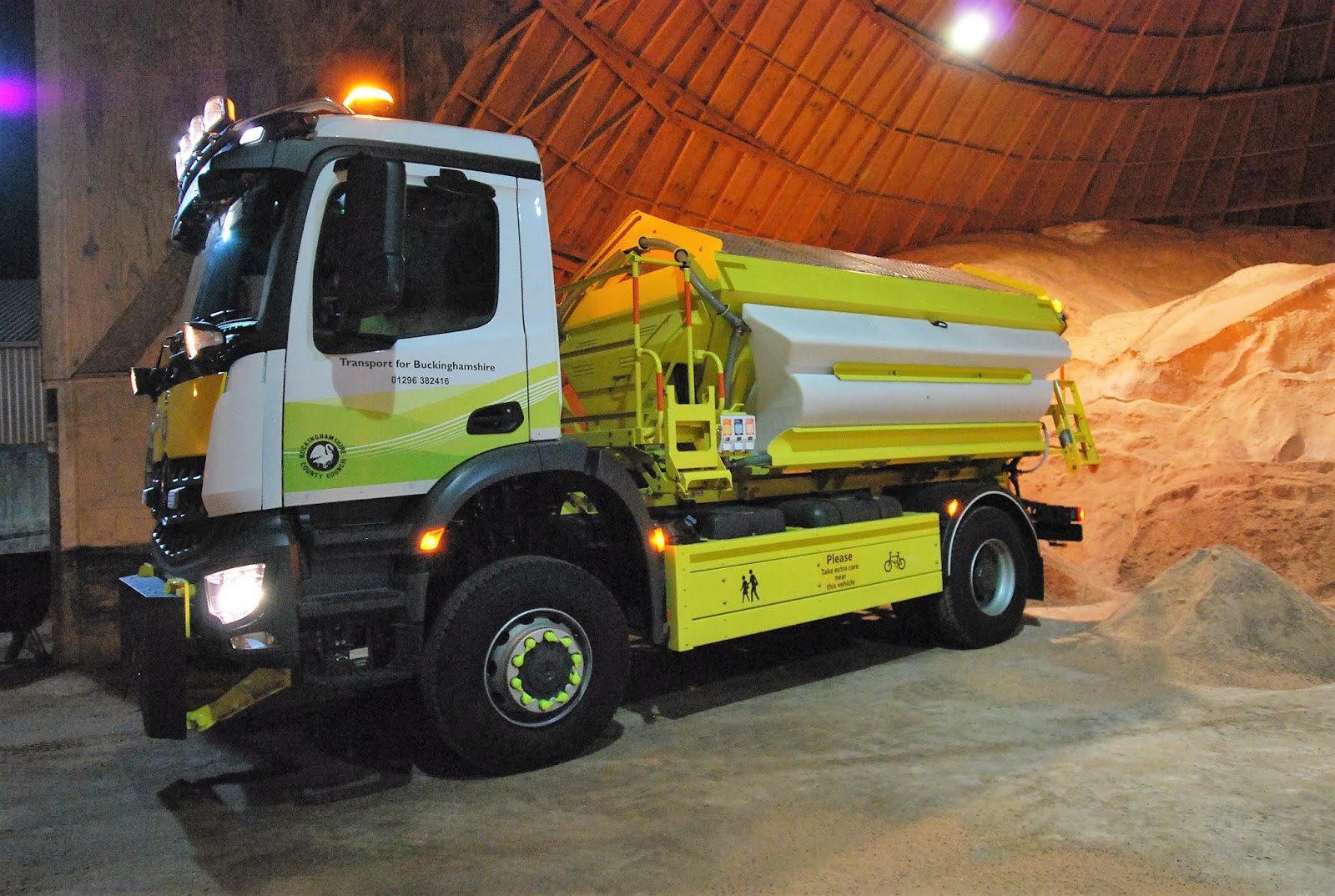
Yes. We have four rock salt barns based across Buckinghamshire in High Wycombe, Amersham, Aylesbury and Buckingham, as well as an emergency reserve of 3000 tonnes of salt near south Bucks, just in case. Each barn holds around 2,000 tonnes of salt at a time and is topped up throughout the winter. Last year, despite three major snow falls (a rarity for Buckinghamshire) we did not run out of salt.

The salt barn at Handy Cross depot

What the heck is a hoar frost?

We will quite often mention if a hoar frost is forecast in our daily gritting updates – a hoar frost is, put simply, a very thick and fibrous looking frost. A lovely fact, courtesy of the Woodland Trust is that hoar ‘comes from old English and refers to the old age appearance of the frost: the way the ice crystals form makes it look like white hair or a beard.’

Hoar frost occurs in much the same way as dew with moisture in the air condensing onto a surface. When the surface (i.e. the road temperature) is below zero, regardless of air temperature, the moisture will condense as ice rather than water – this is a hoar frost. Thus, although conditions may appear perfectly dry, ice can form on cold untreated surfaces. 

Hoar frost

Do you name your gritters like other counties do?

Yes – our gritters are called: Walter the Salter, Salt Disney, Usain Salt, Snow Farah, Grit ‘n’ bear it, Grit Expectations, Gritty Bang Bang, Ice Ice Baby, Snowbot, Rocky Horror, The Gritter Good, True Grit, Betty, Dawn Raider, Salty Snowflake, Brrrrrrrian, Blizzard Wizard, and Snowphie. When they’re out and about you can track them, here.

Can you call the next one Gritty McGritface?

No.


For more information on the council’s winter services, visit buckscc.gov.uk/readyforwinter

Monday, 22 October 2018

TfB to work on bridge and crossing in Marlow this half term


Starting from Monday 22nd October Transport for Buckinghamshire (TfB) will be busy in Marlow Town Centre, including commencing work on the long anticipated bridge bollards upgrade. 

The works are likely to take up to three weeks, depending on weather conditions, and will take place during week nights only with the bridge and road remaining open during the day. During the night closures TfB will also be taking the opportunity to install new pedestrian crossing refuge islands outside Burger’s, as part of a joint scheme with the Town Council, using Local Area Forum funding.
The old bell-shaped bollards will be removed and new, more robust, bollards will be installed on both approaches to Marlow Bridge, which are designed to be much more difficult for HGVs to get through. Both approaches to the bridge will be resurfaced as well. The work will be carried out overnight under a road closure between 9pm and 6am, Monday to Friday, for about three weeks. The bridge will remain open during the day and there will be restrictions in place to protect the bridge when the old bollards have been removed and the new ones not fully installed. 
Demo bollard on display in Marlow last September 

It is anticipated that these sturdier measures will deter and prevent overweight vehicles abusing or ignoring the 3T weight limit on the historic Marlow Bridge. Deputy Leader and Transport Cabinet Member Mark Shaw commented: 
“This work has been a long time coming, and I’m glad that after all the investigations and planning that has been going on behind the scenes we are finally able to move ahead. The new bollards have been designed to be less easy to abuse than the old ones, and will offer additional protection to an important historic structure.”
At the same time, to make full use of the road closure, TfB will begin the first phase of work to install a new crossing point at The Causeway, outside Burger’s, in a joint scheme with the Town Council and Local Area Forum (LAF). This first phase, to install the refuge islands, will be carried out under the same night closures as the bridge works and will take around five nights, depending on the weather. The second phase, to remove the adjacent parking spaces and complete a dropped kerb, will be carried out later in the year.
The plans for the new refuge islands on The Causeway, Marlow town centre 

Marlow’s Mayor, Chris Funnell, enthusiastically welcomed the news that the crossing works are commencing this week, commenting: 
“I’m delighted that after a long campaign to push for this project to get going, the crossing on The Causeway is now finally being started. Safety is our first priority and we need to ensure that everyone, particularly the disabled, young people and the elderly, have a safe way of crossing the road to get to the park. The new refuge will also act as a visual signal to drivers to be vigilant in that area.”
Mark Shaw added “I’m also really pleased that TfB have scheduled the crossing works for the same time as the bridge works – when teams can share road closures it not only minimises disruption in the town, it saves money. I’m looking forward to seeing the new bollards and the crossing completed; I think they will both be good for the town.”
Work commences on the bridge bollards tonight (Mon 22nd) from 9pm, and the crossing works are scheduled to begin on the 29th, weather permitting.

This article was corrected on 23/10/2018 to say that the weight limit is 3T, and not 3.5T as originally stated. 

Sunday, 30 September 2018

It’s National Customer Service Week 2018!


This week is national customer service week and we’ll be focusing on a different element of our customer service every day on Twitter and Facebook – but if  you’re impatient you can see the whole lot here, now…

Our Customer Pledge
Our customer service is based on three core principles; whatever the job we always strive to keep you safe, get the job done, and keep you involved. This is all part of our customer pledge – find out a more on our website.


Reporting to us
Did you know you can report almost anything to us using Fix My Street? Fix My Street is quick, simple, and precise – every report is allocated to the right team quickly, 24/7, and generates a unique reference number so it can be tracked by anyone.  

Who you gonna call?
However, in any emergency it’s best to phone us, and not try to report online or via social media, or post (we really did get a letter about a fallen tree once!). We can be reached 24/7 in an emergency on either 01296 382416 or 01296 486630 (out of hours). Emergencies are things like flooded roads, fallen trees on roads or pavements, or serious and dangerous issues like sinkholes. If you’re not sure what we’re responsible for then check out our day-to-day maintenance page which details everything we take care of. 


Finding out about roadworks in your area
Did you know you can use an interactive map on our website to find out about road works and closures in Buckinghamshire (and beyond)? We’ve put together this 2 minute video guide to show you how to use the map, and its many hidden talents…


We also publish a press release every Friday saying where we will be doing resurfacing works across Buckinghamshire in the coming week. We also put it on our website, here.

Getting communities involved  
We work closely with elected county councillors in Buckinghamshire, as well as parishes, to find out local priorities and issues. We meet regularly via local area forums, working groups, conferences, as well as issuing briefings and information. This helps us shape our long term improvement programme every April.

TfB Stakeholder Conference 2018

TfB Stakeholder Conference 2018


The most important time of year for customer service: Winter!  
Our winter maintenance will be starting soon! To round off national customer service week we’re focusing on how TfB will be getting ready for winter. Every day during the winter we issue daily gritting updates, so drivers can know what to expect on the roads.  You can see the daily alerts on Twitter, Facebook, or on our winter maintenance page on the county council website. We have loads of winter web resources such as gritting maps where you can track our gritters, gritting route maps – we salt 44% of the roads in Buckinghamshire – and road safety advice. Read more on our winter maintenance page.